

Here is the part of a listing that never gets written down: a pair of concert binoculars spends most of the night hanging around your neck and only a few minutes against your eyes. That is the whole honest shape of the thing. And it is why the number that decides whether you reach for them is not the 12x printed across the box. It is whether they sit comfortably enough that you bother, and whether they bring you the stage clearly enough that you catch the good moment instead of fiddling. That honest test is the one most reviews never run, and it is the whole reason I am sitting here writing this.
I am Heidi, and I go to a show nearly every month. My ticket puts me somewhere in the open middle of a big Bay Area room, close enough to feel the bass in my sternum and far enough that the stage reads as a warm blur. For years I told myself the blur was fine, that the music carried the night on its own. Then I picked up the occer 12x25 compact binoculars that everyone in my crowd seems to carry, and I learned the honest truth that never fits on a product page: at 12x your own hands do half the work, the small lens is thinner than it looks, and the focus wheel is the difference between a gadget you carry and a habit you keep. Everything below is that truth, told in the order I ran into it.
The Quick Verdict
Sharper in the center than the listing promises, a genuinely comfortable carry, and it teaches its own learning curve. Set the focus once and brace your elbows and you will see faces from a full arena row. The honest costs are the small lens and the five minutes that 12x takes to click.
Amazon Check Today's Price →See what the occer 12x25 actually shows you
Skip the studio photos and judge the real center sharpness and the lightweight controls for yourself at today's price on Amazon. This is the honest version of what a real venue looks like through this small glass.
Amazon Check Today's Price on Amazon.com -> →How I Actually Used Them
I did not walk straight from the mailbox to a concert, because that is the exact scene where people get defeated and post the two star review. Instead I spent a week rehearsing in daylight. I aimed at the street sign opposite my grocery store, at the hummingbirds that work the fuchsia by my front gate every morning, and at the faded numbers painted on the side of my friend's van. That rehearsal is the quieter reason the first show did not beat me. By the time the lights dropped, I already knew how far to turn and how to plant my elbows, and nothing about the dark was new to my hands.
Then came the real rooms. An outdoor amphitheater outside the city where the headliner's face was a smear of color until I raised the glass. A full arena for a band I have followed since the mid eighties, where the occer brought the guitarist's hands so close I could see every string. And a daytime festival where I sang half the set with the occer in my bag and only lifted them for the songs I truly had to watch. Each room asked the small instrument a different question, and the answer changed every time. That variety is the honest measure no single headline can promise you.
The quiet hero was the size. The occer was small enough to live in the side pocket of my clear bag without a fight, and that convenience is why they got used instead of left at the hotel. The whole mechanics of concert gear is that the thing you never forget is the thing that keeps earning its place every single night. These earn their place because carrying them costs you nothing, and that is the part no studio photograph ever shows you. It is also the reason I could judge them fairly rather than feel loyal to whatever I happened to have on me.
I did not come to the occer with soft expectations. I came with a long memory of borrowed pairs, the heavy theater glasses with the cracked focus, the one bought years ago that sat in a drawer. That string of misses is why I was slow to trust, and it is also why I am careful to give you the misses alongside the wins. A lens that is not honest about its own wobble and its dim edge is not worth a month of my time, and it is not worth yours either. What follows is roughness and all, because that is the only way a review like this has any meaning.
What Nobody Tells You About 12x at a Show
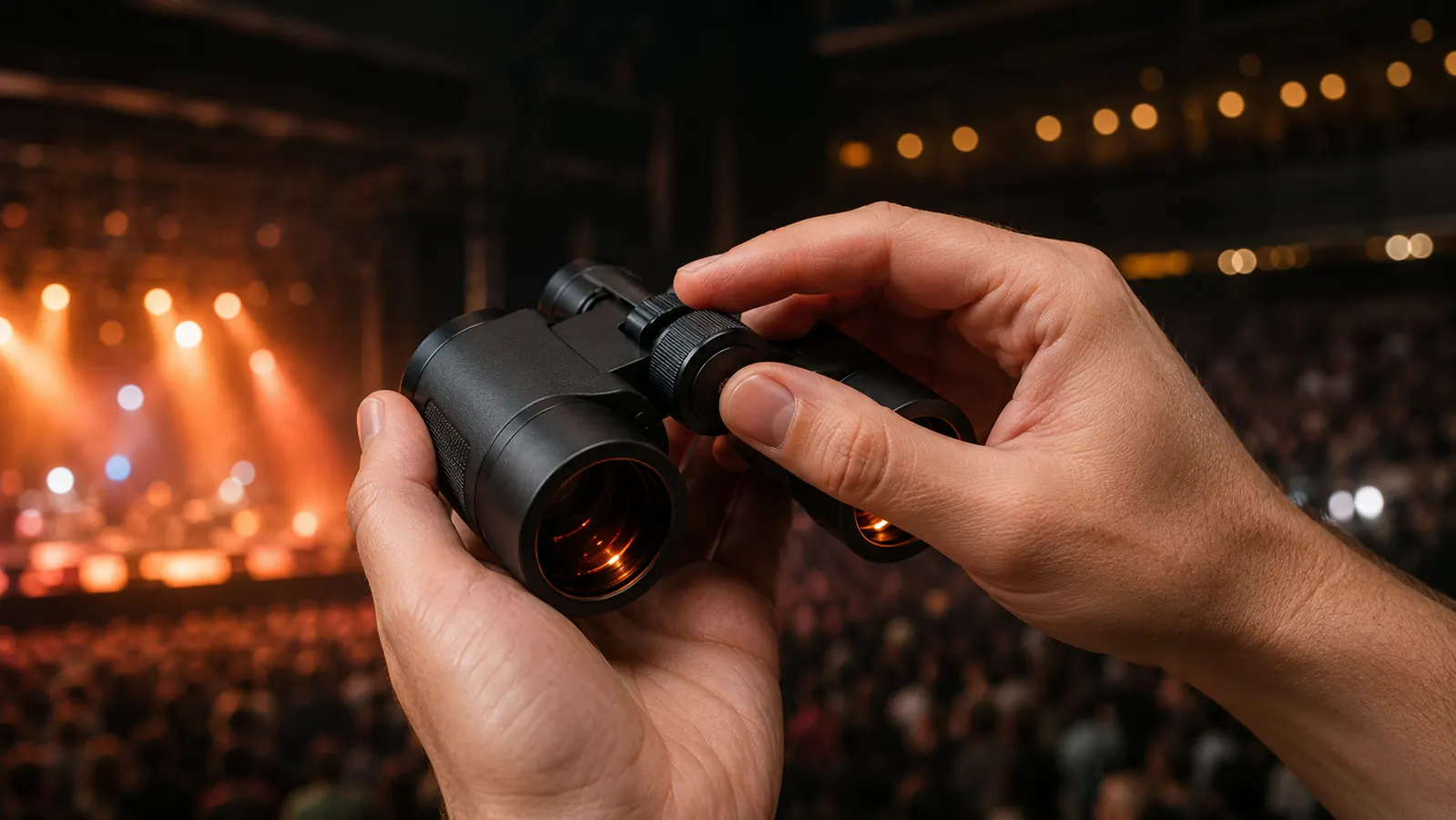
The first thing the ad copy leaves out is the hardest barrier, and it is exactly where the angriest reviews come from. At 12x, your own hands become part of the camera. You can hold yourself still and the frame will still drift a little, because the small shake in everything travels straight through clean optics. The fix is not a stronger arm, it is a bridge. Rest your elbows an inch into the seatback in front of you, or shelf your wrists against a side rail, and the sway mostly evaporates within the first song. Nobody on the box ever says that, and it may be the single most important thing to know before you buy.
The second quiet thing is the focus wheel, and you only feel how much it matters once you are zoomed this close. A grabby or tight wheel would have ended a show night in under ten minutes. Here the wheel turns smooth and a little weighted, and I could hold the view in one frame and dial the guitarist's hands without the image slipping into a smudge. I never once imagined that a smooth slow wheel would turn out to be the feature that decides whether I reach for the glass at all, but at this power it genuinely is. That one underrated control is the difference between a tool and a paperweight, and the occer gets it exactly right.
There is one more surprise, and it is a kindness. Once I stopped trying to freeze the whole picture and instead let the glass ride a little, all rest, the view settled into something almost intimate. The wobble stops being the enemy the moment you accept it, the same way you stop noticing the dram of a ship. That shift happened around the second chorus, and after that I relaxed and watched. It is the reason I tell show friends not to give up in the first ninety seconds, because the first minute is a terrible judge of a 12x lens that only needs a beat to settle into your rhythm.
The Glass: Sharp in the Center, Thirsty in the Edges
Now the honest part about the picture, because the occer is both better and a touch less bright than the big marketing line implies. In the middle of the frame the sharpness is genuinely good. From a full arena row I read the letters on the drum shell, tell a bass player from a keyboard player by what their hands are holding, and watch the exact expression on the singer's face through a quiet verse. That center sweetness is where ninety percent of concert watching actually lives, and it more than pays for the whole ticket.
The trade is the light. The 25 of the 12x25 is not a large front lens, and a small lens gathers less light than a big one. In the dark gaps of a show, the fade before the encore, a dramatic drop to black, the frame goes dim and a half beat soft. You will notice it, and it is not in your head. But keep reading, because the honest boundary is smaller than the worry. The artists light the stage for the people watching them, so the moments that count are almost always bright enough that this small lens keeps up. The dim side shows itself the clearest in a moody room that barely lights its own stage.
If your shows are bright, the weakness rarely surfaces at all. If your idea of a night is a dim nervous room where the band owns the shadows, you will feel it quickly. For the common middle seat at a regular arena, the sharp center wins every argument. Before you pay more simply for a bigger lens, ask yourself the honest question I had to ask: how much extra weight are you going to hang around your neck all night just for a few more photons? That is the real exchange, the honest trade I wanted this review to hold up rather than brush past, and for most of us the small glass is the fair cop.

Grip and the Small Details That Make or Break a Night
The other half is how the occer behaves in a warm hand. The body shelves out exactly where my fingers naturally rest, and the center focus dial hangs right under my right index finger without any reaching. The eye cup twists up so I could watch all night with my glasses on, and the diopter ring on the right barrel let me set my own two eyes once. After that, I never went back to the wheel between songs. That set it and leave it quality is the quiet miracle of a well built small optic, and it is the thing you can only learn by actually wearing a pair through a real show.
By two hundred songs in, the honest familiarity is real. The controls meet my hands the way a good friend meets you at the usual table, no surprise, no hesitation. That is not a thing you get from the big boundless spec sheets, and it is exactly why a compact personal glass usually wins in the hand even when the big pride of sight lines looks better on paper. The occer earns that ease of being the pair I reach for without a thought, and I cannot hand you the sharpness reading alone without also handing you the comfort it rests on.
The small costs are real as well, and an honest review owes them to you. The neck strap is thin, and if you plan to wear these across your chest for a whole double bill, I would swap in a wider one or just carry the occer in its pouch. The bag they ship in is snug, and in the dark I never once got both lens caps back on with a single hand without muscle memory taking over. None of that is enough to send them back, but it is exactly the part a review that never mentions a seam or a strap is leaving out, and for regulars like me that small stuff is half the store.
What I Liked
- The center of the frame is genuinely sharp, enough to read the letters on a drum from a full arena row
- Small, light, and it rides in the side pocket of a clear bag, so it actually gets carried every show night
- The focus wheel is smooth and weighted, which is the hidden make or break at 12x power
- The unfolding eye cup and the diopter take a few seconds once and then never ask again
- The learning curve settles the moment your elbows find the trick, and then a huge stage gets up close to you
Where It Falls Short
- The 12x sways with your own hands until you learn to brace your elbows, so the very first song is the roughest one
- The small 25mm lens is not as bright as bigger glass at the weakest moment of a dark stage
- The included neck strap is thin and the protective pouch is snug to reach into in the dark
- The learning curve means the first few minutes are not the best; some first timers give up before it clicks
At twelve times, your own hands become part of the camera. Brace your elbows against the seatback, and a whole big stage comes walking up to you.
Who This Is For
These are for the person in the middle a big room who has quietly agreed that the performer is a bright shape and the sound is the real show. If that is you, then the occer wins your entire night back without asking you to learn anything heavier than a sandwich. They are for the fan who brings the glass up twice a set, when the light catches something worthwhile, and wants the rest of the night free to clap and to sing along. That rhythm of short looks and long love is the natural life of a compact lens like this as much as the big one.
They are also the right pair if you are new to optics and the idea of a heavy black brick is doing more harm that good. The size and the easy wheel mean you can carry them, set them, and forget them, which removes the real reason most people abandon a nice thing after a single trip. And because that is the actual gate, the occer is a smart intro for a first season of seriously watching the stage. The more nights you give the little lens its own pace, the more of the show you get back. For the whole arc measured across an entire season and every kind of chair I bought, my long term review holds the longer trail.
Who Should Skip It
Let them go if you are the kind of person who folds at the first bit of wobbly and will not spend ninety seconds learning the elbow. The 12x asks for those moments of effort, and if you will not give it, you will only be trading a clear blur for a messy smear and feel even worse about it. If you only ever sit so far back that you need the deepest reach, the honest trade the small lens makes in the dark corners of the show may leave you wanting for the big glass, and the dim edge will feel louder, the longer it goes.
And if the room you love best is the sort of dim, moody house a band keeps low on purpose, the lack of brightness may cost you the very thing you came to see. That is a fair boundary for any small optics, and I would rather walk you toward a wider lens than pretend the occer is brighter than it is. That honest counsel is the difference between a real review and one that just nods along. And if you are weighing the occer against one rival and want the whole argument side by side, my occer versus Autosports comparison sets both narratives out together clearer than any single night can.
Bring a whole big stage down to the very front row
Exactly what the sharp center, the easy carry, and the honest small lens trade look like at today's price on Amazon. And a fair warning: the night gets brighter the moment you learn the elbows, and that ninety seconds of effort is the best value in the whole review.
Amazon Check Today's Price on Amazon.com -> →